
Use case
Healthcare & life sciences
The integration burden is the project. It always was.
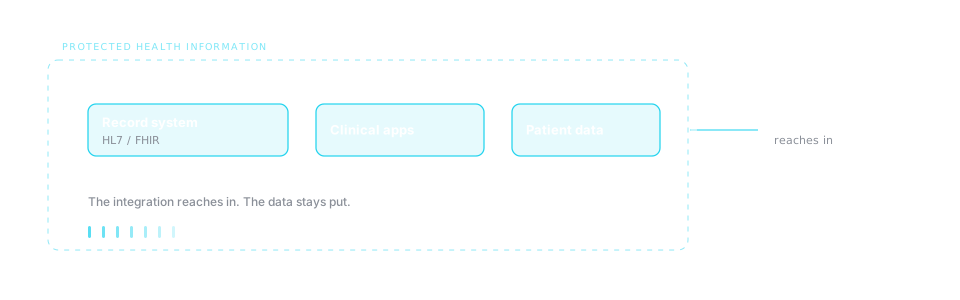
Clinical AI does not usually fail on clinical grounds. It fails because getting it into the workflow means touching an EHR, an identity system, a scheduling system, and a data warehouse — each with its own owner, its own change window, and its own view of what a patient identifier means.
Meanwhile the compliance surface means the tooling itself has to be defensible before the thing it builds can be.
01 — Where it stalls
What actually slows this down
PHI constrains every tool choice
Anything that could see protected health information needs an agreement, a review, and a boundary you can point to on a diagram.
Integration surfaces are unforgiving
Interface engines, message formats, and site-specific customisations mean the same integration is genuinely different at each site.
Clinical workflow tolerance is low
If it adds clicks it will not be used, regardless of how good the underlying model is.
02 — What Orfyn takes on
The work that stops being manual
- 01
Inspect interface configurations and message samples in place rather than by request
- 02
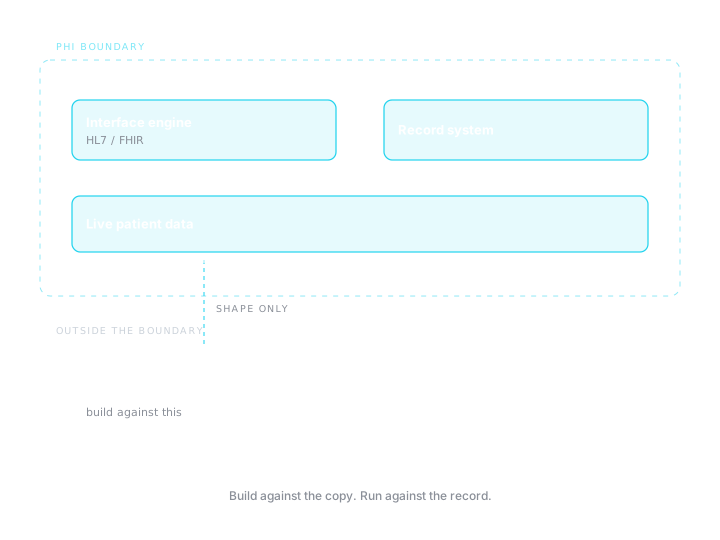
Build and test integrations against a de-identified copy in an isolated worktree
- 03
Enumerate failure branches explicitly before anything reaches a clinical environment
- 04
Keep site-specific variations as versioned configuration instead of tribal knowledge
- 05
Re-run the full verification set when a system upgrade moves the ground
03 — The deciding constraint
The boundary has to be drawable
Orfyn runs on infrastructure you control, under credentials you issue. Agents reach what the machine and those credentials reach, and nothing is escalated on your behalf — so the data boundary in the architecture diagram is the actual boundary.
Walk us through your version of this.
Bring one workflow you are trying to ship. We will go through what it touches, where it stalls today, and what running it on Orfyn would look like.