AI Forward Deployed Engineer

OrfynThe new era of AI FDE.

An AI forward deployed engineer for the work that decides whether a pilot ever ships: discovery, system archaeology, field mapping, verification against the real rules, and the change requests that never stop after go-live — running on your infrastructure, under your credentials, inside your review process.

The category, as covered by

Financial Times
Deloitte
Forbes
The Wall Street Journal
MIT
Gartner

01 — The gap

AI doesn't fail in the demo. It fails after.

A model that answers well in a sandbox tells you almost nothing, because production failure looks nothing like a wrong answer. It looks like an integration surface the model cannot reach. Two systems whose fields share a name but not a meaning. An approval branch the demo never exercised. A permission boundary that works only for the engineer who built it. An upstream schema that quietly moved in June, three months after go-live.

The role invented to close that distance is the forward deployed engineer — someone who sits inside the business, learns how it actually operates, translates that into something buildable, ships it, and owns the outcome afterwards. It works. It is also headcount: every enterprise is hiring for the same scarce people, capacity grows one engineer at a time, and the context walks out the door with them.
800%+
growth in forward-deployed-engineer job postings during 2025Source: Financial Times
95%
of enterprise GenAI pilots show no measurable P&L impactSource: MIT — NANDA initiative, 2025
30%
of generative-AI projects forecast to be abandoned after proof of conceptSource: Gartner
“The FDE model is rapidly gaining momentum as organisations look to fast-track AI integration and adoption by embedding engineering talent directly with client teams.”
DeloitteGlobal consultancy
“The forward deployed engineer fills that gap, ensuring that AI progresses with customers rather than drifting away from their needs.”
ForbesBusiness press
“AI companies are hiring forward-deployed engineers to work directly with customers and tailor AI tools to real-world use cases.”
The Wall Street JournalBusiness press

02 — The role

What a forward deployed engineer actually does

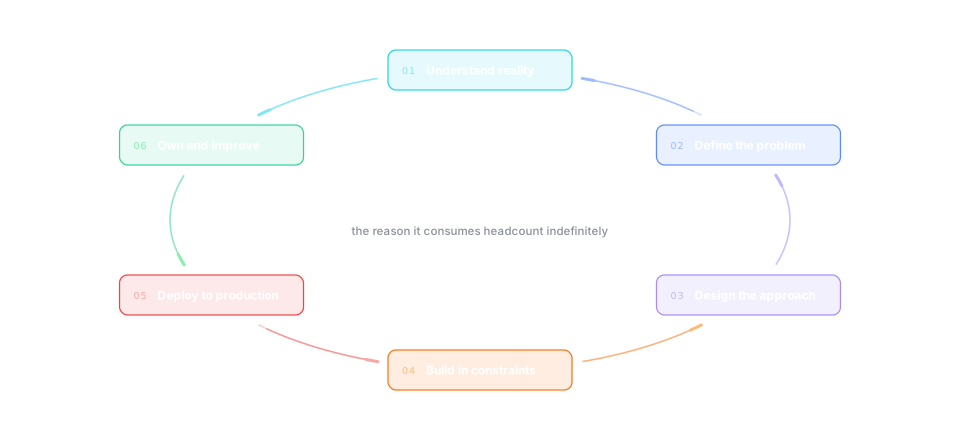
Six steps, run in a loop. It is not a mystery — it is just relentless, and it is where the headcount goes.

  1. 01

    Understand the business reality

    How the work actually happens, not how the requirements document says it happens.

  2. 02

    Define the right problem

    Turn business pain into a specific, solvable problem worth pointing a model at.

  3. 03

    Design the approach

    Decide what the system does, what data it touches, and how anyone will know it worked.

  4. 04

    Build within real constraints

    Fit the existing stack — the data, the permissions, the network, the compliance review.

  5. 05

    Deploy into production

    Ship into a live environment where real people now depend on it.

  6. 06

    Own outcomes and improve

    Watch it, fix what fails, and keep changing it as the business changes underneath.

The six steps a forward deployed engineer runs, drawn as a repeating loop rather than a sequence.

Orfyn does not replace the judgement in steps one and two. It removes the reason those steps stall — the months of execution behind them.

03 — The software

Implementation that runs like a product, not a project.

Orfyn is a self-hosted platform for running and orchestrating coding agents against your real systems. Five things make it usable on work that matters.

01

Compress the timeline

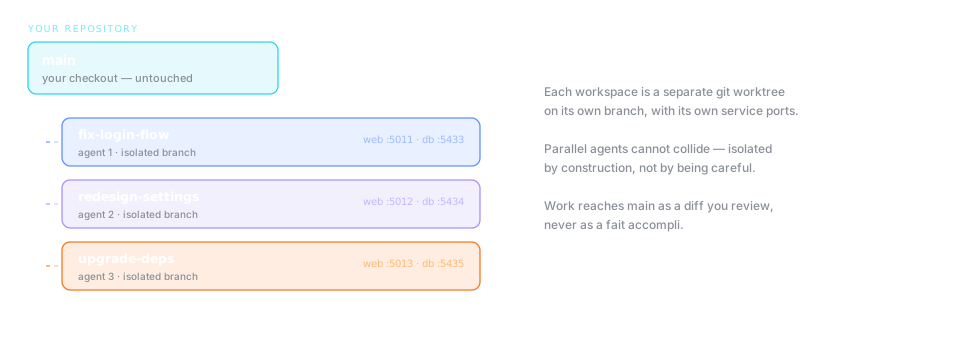
Run many agents at once instead of one engineer in sequence. Each gets its own isolated checkout, so parallel work does not collide.

  • Multiple agents on the same repository via git worktrees
  • Agents, terminals, and browsers side by side in one workspace
  • Agents keep running when you close the client
02

Safe enough to touch production

Nothing lands on main because an agent decided it should. Work happens in isolation and arrives as a diff you review.

  • Every workspace is an isolated worktree, not your main checkout
  • Per-worktree allocated ports for dev servers and databases, so nothing collides
  • Review the diff in the app before it merges
03

Deterministic where it counts

The parts that must be repeatable are scripts, not prompts. Anything you can do in the interface, you can run unattended.

  • The CLI exposes the same surface as the app
  • Scheduled agents on cron-style triggers
  • An MCP server so your existing agents can drive Orfyn directly
04

Runs on your real stack

The daemon runs on your hardware — a laptop, a homelab, a server in your own VPC. Your code does not leave it, and we do not sit in the path of your model calls.

  • Self-hosted daemon; clients connect locally or over a relay
  • Bring your own keys — your Claude, OpenAI, or self-hosted endpoint
  • No telemetry on your code
05

Implementation never ends

The second change should cost less than the first. Context lives in the workspace, so the system that shipped is still the system you edit.

  • Workspaces persist across sessions and devices
  • Desktop, mobile, web, and terminal against the same daemon
  • Switch providers without rebuilding the workflow
A main checkout alongside three isolated git worktrees, each on its own branch with its own allocated service ports.
Works with your stack

04 — Integrations

If it has an API, a CLI, or an MCP server, an agent can drive it.

No connector catalogue to wait on. Agents operate the systems your teams already run — from the ERP to the CI pipeline — using the same interfaces your engineers use, under the same credentials.

Systems of record & GTM

SAP
Salesforce
ServiceNow
HubSpot
Workday
Oracle NetSuite
Snowflake
Databricks

DevOps & infrastructure

Azure DevOps
GitHub
GitLab
Jira
Jenkins
Docker
Kubernetes
Terraform
AWS
Microsoft Azure

Agent harnesses it runs natively

UpfynAI
Claude Code
Codex
GitHub Copilot
Cursor
Gemini
OpenCode
Cline
Goose
Qwen Code
Kimi
Amp
Factory Droid
Mistral
Poolside

All product names and logos are property of their respective owners, shown to indicate systems Orfyn agents can operate — not partnership, certification, or endorsement.

05 — Where it runs

It runs where your work already lives.

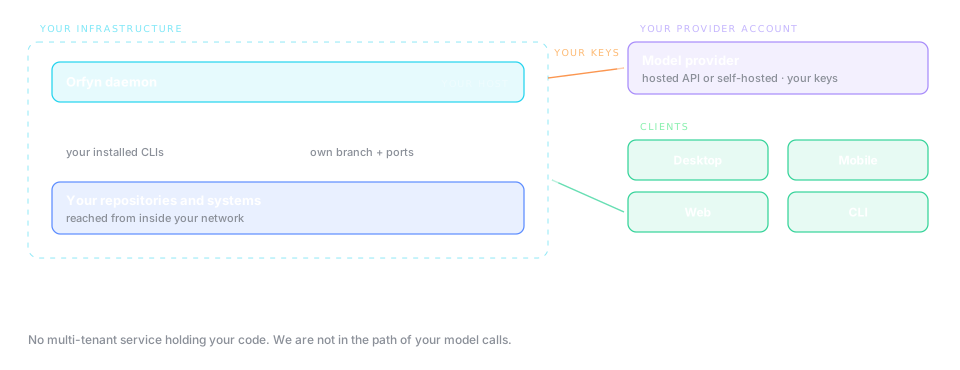
Most AI vendors ask you to move your work to them. Orfyn is the other shape: the daemon runs on your machine, holds your keys, and talks to your systems from inside your network. There is no vendor session in the middle to audit, because there is no vendor session.

Your infrastructure

Laptop, homelab, or a server in your own VPC. macOS, Windows, and Linux are all first-class.

Your keys

Bring your own provider accounts. Orfyn does not proxy model calls and adds no margin on inference.

Your boundaries

Agents reach what the machine and the credentials they run under can reach. Nothing is escalated on your behalf.

Your call on the model

Multi-provider by design. The best model changes every few months; the workflow around it shouldn't have to.

Where Orfyn runs: the daemon on your infrastructure, clients connecting to it, and model calls leaving on your own credentials.

Engineered to clear an enterprise review

SOC 2

built against control objectives

ISO 27001

aligned control design

UK/EU GDPR

privacy by architecture

DPDP Act 2023

India-ready

E2E encryption

relay carries ciphertext only

Self-hosted

your keys, your network

Certification status, control evidence, and completed questionnaire responses are available under NDA — ask for the security package in the meeting.

06 — Go deeper

Read the parts that matter to you.

07 — Who it's for

One platform. Three ways in.

The same daemon, the same isolation, the same review-before-merge — scaled to the size of the team running it.

Startups

More surface area than headcount.

  • Run three parallel efforts with one engineer
  • Your existing model subscriptions — no inference markup
  • Ship from a laptop today, a VPS tomorrow

MSMEs

Enterprise problems without enterprise headcount.

  • Automate the integrations you keep re-buying consulting for
  • Runs on hardware you already own
  • One platform instead of five point tools

Enterprises

Capacity without the security fight.

  • Inside your perimeter, under your credentials
  • Every change lands as a reviewable diff
  • Security package available under NDA

08 — Feedback

Feedback

Published only with written permission — every quote on this wall will carry a name, a role, and something checkable.

C

Awaiting publication

CTO · Early deployment

This slot is reserved for permissioned feedback from an early production deployment.

HO

Awaiting publication

Head of Platform Engineering · Early deployment

Operator quotes are published only with written sign-off — names, roles, and results included.

VE

Awaiting publication

VP Engineering · Early deployment

First-cohort feedback lands here once the deployment it describes is live and verified.

F

Awaiting publication

Founder · Early deployment

No invented praise. Every quote that appears on this wall will be attributable and checkable.

DO

Awaiting publication

Director of Data · Early deployment

Reserved for the team that ships the first regulated-environment rollout on the platform.

EM

Awaiting publication

Engineering Manager · Early deployment

Until then: bring one workflow to the meeting and judge the work directly instead.

These are reserved slots, not customers. Ask in the meeting for reference calls while the wall fills in.

09 — Questions

The questions that come up first

Is this a consulting engagement or software?

Software. The forward-deployed-engineer model works because someone technical owns the outcome inside your business — but delivered as consulting, it costs what consulting costs and stops when the engagement stops. Orfyn is the platform that does that work, running on your side.

Where does our code and data go?

Nowhere. The daemon runs on hardware you control and talks to your systems from inside your network. You supply your own model provider keys, so inference goes directly from your infrastructure to the provider you chose. There is no telemetry on your code.

Which models does it use?

Whichever ones you want. Orfyn is multi-provider by design and runs the agent harnesses your engineers already use — Claude Code, Codex, Copilot, OpenCode, and others, alongside custom providers. You can switch without rebuilding anything around them.

What stops an agent from breaking production?

Isolation, not good intentions. Agents work in separate git worktrees with their own allocated service ports, so parallel work cannot collide and nothing touches your main checkout. Changes reach you as a diff to review.

What happens in the meeting?

You bring one workflow you are actually trying to ship. We go through what it touches, where it currently stalls, and what running it on Orfyn would look like. If it isn't a fit, we will say so in the meeting rather than after it.

Bring one workflow that's stuck.

The fastest way to find out whether this fits is to walk through something real. No deck, no download, no trial to configure.

Book a meeting