
How it works
One deployment, start to finish.
The shape of the work is the same everywhere: understand the process, find the fields that matter, build the connection, then keep it alive. Here it is end to end.
The walkthrough below is illustrative — a representative internal-procurement integration, not a customer case study.
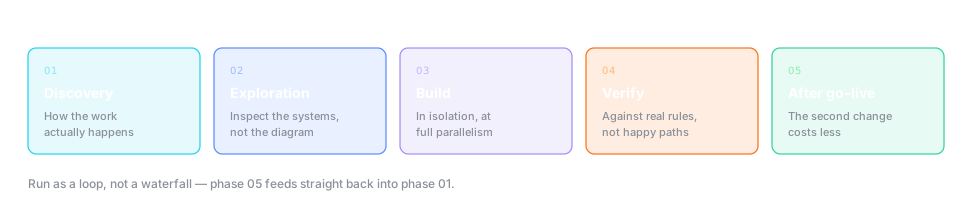
01 — Discovery
Find out how the work actually happens
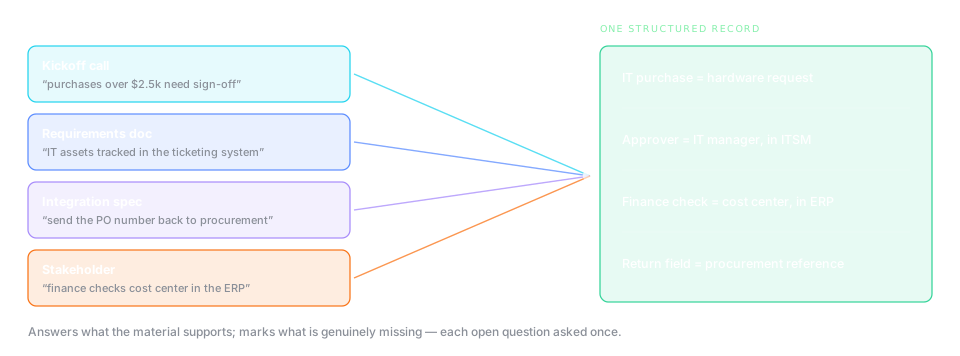
Before anything connects to anything, someone has to answer unglamorous questions. Which purchases need approval, and above what amount? Who signs off when it crosses a threshold? Which finance check runs before the ticket closes? What does a requester's identity look like in each system?
The answers are never in one place. They are spread across a kickoff call, a requirements document nobody has opened since it was written, an integration spec, and three people who each know one part.
Orfyn opens a workspace for the project and reads what exists — transcripts, docs, specs, the repository itself. It answers what it can from the material, and marks what is genuinely missing so a human can answer it once rather than four times.
02 — System exploration
Look inside the systems, not at the diagram
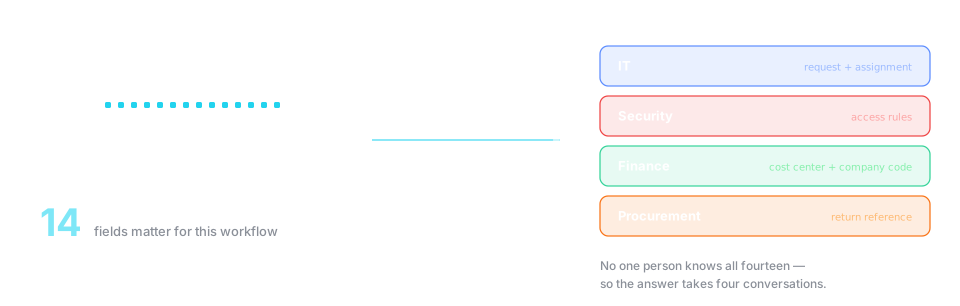
Enterprise systems are large in a way that architecture diagrams hide. A single ticketing platform can expose several thousand fields. Fourteen of them matter for this workflow, and responsibility for those fourteen is split across IT, Security, Finance, and Procurement.
Nobody has that map in their head, and the documentation describes an older version of the configuration. So Orfyn connects to the systems and inspects them directly — the actual schema, the actual custom fields, the actual permission model as deployed.
This is the step that quietly consumes weeks of a forward deployed engineer's time, and it is almost entirely mechanical.
03 — Build
Build the connection where it can't hurt anything
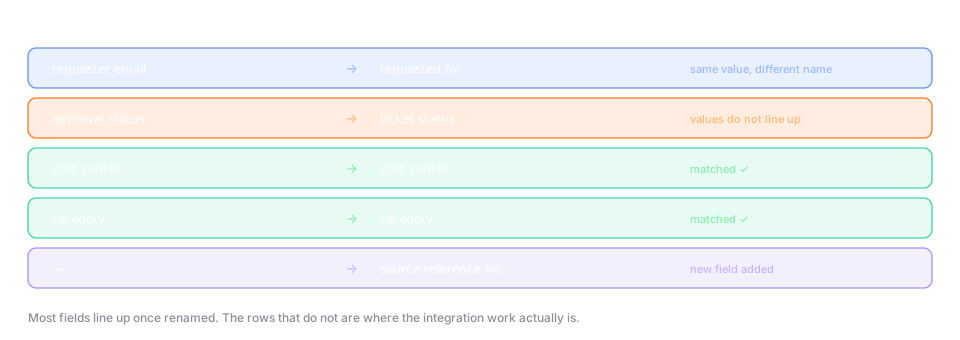
Field mapping is where the real disagreements surface. Two systems have a field with the same name and different meaning, or the same meaning under different names, or a status set that doesn't align at all.
Work happens in an isolated worktree with its own allocated service ports — a real, runnable copy of the stack that is not your main checkout. Agents run in parallel there: one on the mapping, one on the tests, one on the migration. Nothing they do is visible to production until you look at the diff and merge it.
04 — Verify
Prove it against the rules, not against a happy path
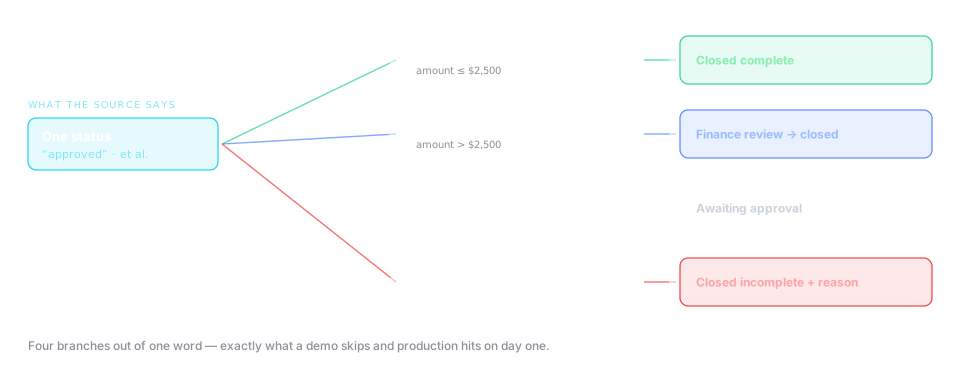
The rule is rarely 'approved means closed'. It is 'approved means closed, unless the amount crosses a threshold, in which case finance reviews it first, and rejection has to carry the reason back'.
Those branches are exactly what a demo skips and production hits on day one. They get written down as explicit cases and run end to end before anything ships.
05 — After go-live
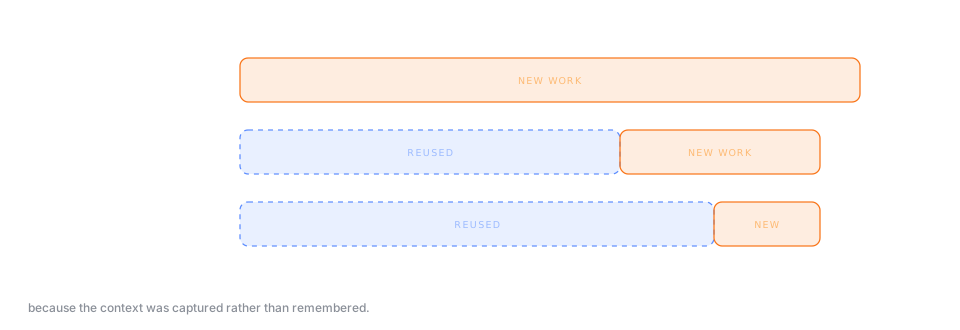
The second change costs less than the first
Go-live is not the end of an implementation, it is the start of the expensive part. The threshold moves from $2,500 to $5,000. Procurement adds a category. A system upgrade renames three fields.
Traditionally each of those is a small project, because the context that made the first build possible left with the engineer who did it. In Orfyn the workspace persists — the environment, the history, and the reasoning are still there.
So the next change request is an edit, not a rebuild.
That's the whole loop.
Understand, explore, build in isolation, verify against the real rules, and keep owning it. Run continuously, by software, on your infrastructure.